

Key Takeaways
Good parts decisions begin with accurate vehicle information and end with disciplined workshop processes. The right system helps mechanics protect safety, time, cash flow, and customer trust.
- Group parts by their role, risk, and vehicle application.
- Use the VIN, specifications, and repair history before ordering.
- Judge quality through standards, traceability, warranties, and supplier conduct.
- Stock common service items while limiting obsolete inventory.
- Treat receiving, labeling, documentation, and communication as part of the repair.
Understand the main categories of car parts
A workshop handles far more than engine components. Parts affect propulsion, braking, control, comfort, appearance, and routine maintenance, so a useful category system should reflect how technicians diagnose and repair vehicles. The Car Parts Supplier connects customers with quality used, genuine, and aftermarket parts, making it easier to think about selection by application rather than by a loose list of products.
Engine and drivetrain components
Engine and drivetrain parts transfer energy from combustion or an electric motor to the wheels. Depending on the vehicle, this group can include filters, belts, pulleys, gaskets, pumps, sensors, clutches, transmissions, driveshafts, differentials, and related mounting hardware. A part that looks interchangeable may still differ in dimensions, calibration, material, or connection points, so the original application matters from the first search.
When diagnosing a fault, consider the complete system rather than replacing the first failed-looking component. A worn mount can create vibration, while a cooling problem can damage otherwise sound engine parts. Recording the cause of failure alongside the replacement part helps prevent repeat repairs.
Brake, steering, and suspension parts
Brakes, steering, and suspension directly influence how a vehicle stops, turns, and remains stable. Pads, rotors, calipers, hoses, wheel bearings, control arms, ball joints, tie rods, shocks, struts, and springs all require careful matching. Small differences in load rating, diameter, thread size, or sensor provision can affect installation and road performance.
These are not ideal areas for guesswork or unexplained substitutions. Check the vehicle specification, compare the old part, and follow fitting requirements such as torque settings, bedding procedures, alignment, and hydraulic bleeding. The cheapest item is a poor choice if it introduces noise, uneven wear, or a safety concern.
Electrical and electronic systems
Modern vehicles depend on interconnected electrical and electronic systems, including batteries, alternators, starters, wiring, fuses, relays, sensors, control modules, cameras, and lighting. Diagnosis may involve voltage, resistance, continuity, communication faults, and software-related symptoms. A replacement must match both its physical connection and its electrical behavior.
Before ordering, establish whether the fault lies in the component, its wiring, its power supply, or its control signal. Testing first reduces unnecessary returns and protects technicians from installing a good part into a faulty circuit. Keep connectors clean and protect sensitive modules from moisture and static damage.
Body, interior, and service items
Body and interior parts include mirrors, lamps, panels, handles, trims, seats, switches, wiper mechanisms, and cabin fittings. Service items cover filters, fluids, bulbs, wiper blades, belts, clips, fasteners, and other consumables used during regular maintenance. Their value may be modest, but availability strongly affects how quickly a job can be completed.
Used parts can be sensible for appearance or trim repairs when condition and color are verified. For service items, confirm the correct specification, capacity, dimensions, and replacement interval. Keeping these categories separate in the storeroom makes both estimating and picking faster.
Match parts to vehicle requirements
Correct identification is the foundation of sourcing car parts for mechanics and workshops. Make, model, year, engine, trim, drivetrain, and production changes can all affect fitment. Before comparing price or delivery, establish exactly which vehicle configuration the part must serve.

A disciplined identification process prevents avoidable delays and gives the technician a defensible reason for the chosen part. It also makes customer conversations clearer when several options are available.
Use the VIN for accurate identification
The VIN is a strong starting point because it links the vehicle to its build information and helps distinguish similar models. Record the VIN alongside registration details, engine code, transmission type, and any relevant production date. The VIN should support the search, not replace a final check of the part and the vehicle in the workshop.
For older vehicles, catalog records may be incomplete or show several revisions. Ask for photographs, the original part number, connector details, or measurements when the catalog alone leaves uncertainty. A few minutes spent confirming identity is usually cheaper than arranging a return after dismantling has begun.
Compare OEM, aftermarket, and remanufactured options
An OEM part follows the vehicle maker’s original specification, while an aftermarket part is produced by another manufacturer and may offer a different price or design. A remanufactured component has been restored and tested according to the remanufacturer’s process. The best option depends on the repair’s safety implications, the vehicle’s age, the customer’s budget, and the availability of technical support.
Discuss the trade-off plainly rather than treating one category as automatically suitable. For a high-risk system or a difficult-to-access component, consistency and traceability may outweigh a small initial saving. For an older vehicle, a well-matched quality alternative may be a practical way to keep the repair affordable.
Check fitment, specifications, and compatibility
Fitment means more than whether a component can be bolted into place. Check dimensions, operating range, load rating, materials, connector design, sensor provision, software requirements, and any installation hardware. Compare catalog data with the removed part and with the vehicle manufacturer’s repair information where available.
A useful workshop record should capture the supplied part number, superseded number, supplier reference, and any compatibility notes. Accurate part records save labor because the next technician can understand what was ordered and why. This is especially valuable when the same vehicle has several engine or braking configurations.
Account for vehicle age and modification history
Age changes the sourcing decision. Rubber components may have deteriorated, previous repairs may have introduced non-standard hardware, and an older vehicle may have received an engine, suspension, wheel, or electrical modification. Ask the customer about prior work and inspect the vehicle before committing to a part.
Modification history should be treated as evidence, not an inconvenience. Photograph unusual brackets, connectors, and mounting points, then confirm whether the replacement must follow the original configuration or the current one. If a vehicle has been altered, note the limitation in the estimate so expectations remain clear.
Evaluate quality, safety, and supplier reliability
A part is only useful when it is suitable, safe, and available when promised. Workshops need a repeatable way to assess suppliers rather than relying on packaging or a familiar-looking catalog image. Quality checks should continue from the first quotation through delivery, installation, and warranty support.
The Car Parts Supplier provides access to quality used, genuine, and aftermarket parts through a car parts network serving Melbourne, Sydney, Brisbane, and customers nationwide. That geographic reach can help workshops source options, but each individual part still needs to be checked against the vehicle and repair requirement.
Review certifications and manufacturing standards
Ask what standards, testing, or traceability apply to the part and its manufacturer. Documentation should be relevant to the component, current enough to be useful, and consistent with the claims made in the catalog. For safety-related items, technicians should be especially cautious about unclear certification, missing batch information, or vague descriptions.
Standards do not remove the need for inspection. Confirm that the delivered item matches the quoted specification, packaging, and identification marks. Keep copies of useful documentation with the purchase record so questions can be answered later.
Identify signs of counterfeit or low-quality parts
Suspicious packaging, inconsistent logos, poor casting, rough machining, incorrect labeling, missing instructions, and unusually low prices can all justify further investigation. Compare the item with known photographs or the original component, but do not rely on appearance alone. A part that passes a quick visual check may still have incorrect material or internal construction.
Quarantine anything that seems doubtful instead of placing it in general stock. Photograph the packaging and part, record the order details, and ask the supplier for clarification. This protects customers and prevents an uncertain item from being fitted to another vehicle.
Assess warranties, returns, and technical support
A warranty has practical value only when its terms are understandable and the supplier can process a claim efficiently. Check coverage periods, installation conditions, excluded failures, proof requirements, and who pays return freight. Also ask whether technical support is available when a part does not behave as expected.
Return rules should be considered before ordering, particularly for electrical modules and special-order items. Record the vehicle information, diagnostic findings, and fitting details so a legitimate issue can be explained without reconstructing the job from memory.
Build relationships with dependable suppliers
Reliability shows up in ordinary interactions: accurate quotations, honest availability, protective packaging, prompt answers, and consistent handling of errors. A supplier who asks for the VIN or clarifies an uncertain application is often more useful than one who simply promises the fastest dispatch.
Review performance over time using delivery accuracy, return outcomes, part quality, and response time. Keep more than one approved source for essential categories, while avoiding a constantly changing list that makes standards difficult to maintain. Consistent expectations improve both purchasing and customer service.
Choose parts for common workshop jobs
Workshops can predict a large share of their demand by reviewing repair orders and maintenance schedules. The aim is not to hold every possible part, but to keep common items ready and create a clear process for less frequent jobs. The Car Parts Supplier helps customers find parts fast and affordably across Melbourne, Sydney, Brisbane, and nationwide, while workshop stock still needs to reflect local vehicle patterns.
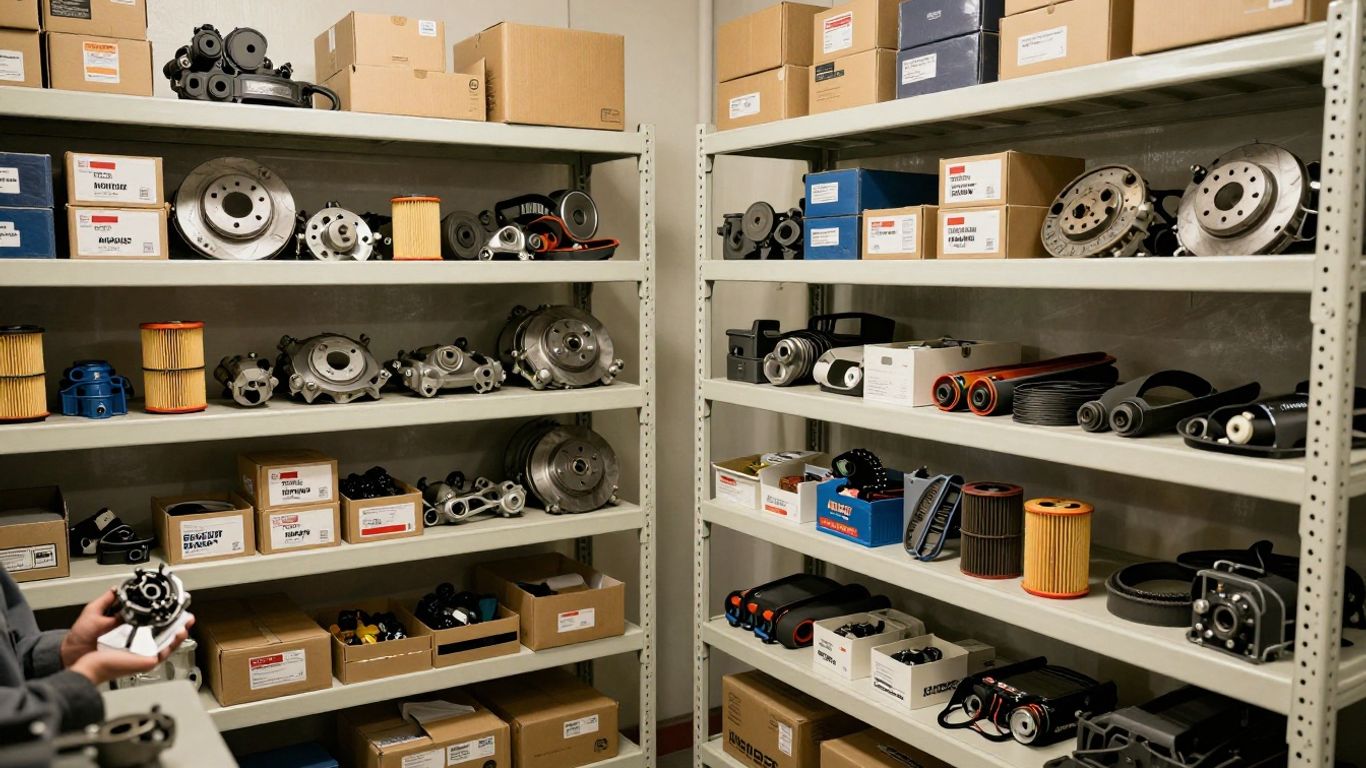
A practical stock plan combines fast-moving consumables with carefully selected components for frequent repairs. It should also leave room for vehicle-specific ordering when holding a part would create too much waste.
Stock fast-moving maintenance parts
Start with items used during routine servicing: oil, air, cabin, and fuel filters; spark plugs; wiper blades; common bulbs; belts; fluids; and frequently used seals or clips. Choose quantities based on actual usage, not a generic list. Keep part numbers and equivalent specifications visible so a substitute is not chosen casually.
Review these items often because demand can change with fleet contracts, seasonal travel, or a new vehicle population in the local area. Fast-moving stock should be easy to count and replenish without interrupting technicians.
Prepare for brake and suspension repairs
Brake and suspension demand is often predictable, but applications can vary sharply within one model range. Hold common pads, rotors, wear sensors, bushes, links, bearings, and related hardware only where usage supports it. Make sure paired components and fitting accessories are considered when quoting the job.
A repair plan should identify whether additional work may be needed, such as alignment, hydraulic service, or seized fastener replacement. That does not mean ordering unnecessary parts; it means checking availability early and giving the customer a realistic scope.
Cover common engine and cooling-system work
Cooling repairs may involve hoses, thermostats, radiators, caps, fans, pumps, belts, and sensors. Engine service work can also call for gaskets, filters, plugs, tensioners, and seals. Store parts by application and specification because visually similar items may have different pressure ratings, dimensions, or temperature limits.
Before fitting a cooling component, investigate the reason for the original failure. Flushing, pressure testing, bleeding, or checking the fan control may be necessary to prevent a replacement part from failing in the same unresolved system.
Keep diagnostic and electrical repair components available
Electrical work benefits from a small, reliable supply of fuses, relays, terminals, connectors, bulbs, cable protection, and approved repair consumables. Keep diagnostic adapters and testing accessories organized, but do not treat a replacement module as a substitute for diagnosis. Compatibility may depend on programming, coding, or the vehicle’s communication network.
A useful electrical stock list can include:
- Common fuse and relay types used by local vehicles.
- Matching terminals, connectors, seals, and repair wire.
- Standard bulbs and connector repair materials.
- Battery, charging, and starting-system service items.
These items support quick repairs without encouraging parts swapping. After installation, test the circuit and record the result so the repair history shows whether the fault was resolved.
Manage inventory efficiently
Inventory is a working tool, not simply a pile of capital on shelves. Too little stock causes delays, while too much hides cash in items that may never be used. A clear system helps the workshop see what is available, what is committed to a job, and what should be ordered next.
Set minimum and maximum stock levels
Set a minimum level for parts that must remain available and a maximum level that reflects realistic demand. Consider average usage, supplier lead time, delivery reliability, and the consequences of running out. A high-risk or essential consumable may deserve a larger buffer than a slow-moving trim item.
Review these levels after changes in workload or supplier performance. Seasonal demand, fleet customers, and new vehicle patterns can make an old setting inaccurate. The goal is controlled availability, not permanently full shelves.
Organize parts by category and vehicle application
Use clear zones for maintenance items, braking, suspension, electrical components, engine parts, body items, and special orders. Within each zone, arrange stock by part number or application rather than by the date it arrived. Keep returned, quarantined, and customer-reserved items physically separate.
Labels should show the part number, description, application notes, quantity, and storage location. For used parts, add condition notes and photographs where helpful. A technician should be able to find the item without asking the purchaser to interpret an informal shelf system.
Track usage, lead times, and seasonal demand
Measure what leaves the storeroom, how quickly suppliers deliver, and how often orders are delayed or returned. The record does not need to be complicated; consistent entries are more useful than a sophisticated system that no one updates. Compare usage against repair orders to identify genuinely fast-moving items.
Use the information to adjust purchasing before busy periods. A workshop that sees repeated demand for cooling or air-conditioning work can prepare appropriately, while still avoiding broad seasonal buying based on assumptions.
Reduce obsolete and slow-moving inventory
Review items that have not moved, especially parts tied to discontinued models or earlier vehicle revisions. Check whether they can be returned, transferred, bundled into a repair, or sold through an appropriate channel. Do not quietly mix questionable or outdated stock with current inventory.
The Car Parts Supplier can help workshops source parts when a vehicle-specific requirement arises, reducing the pressure to keep every uncommon item on hand. The broader principle is simple: buy with evidence, and review stock before it becomes invisible.
Control costs without compromising repairs
Cost control should include the whole repair, not just the number printed beside a part. A cheap component can become expensive when it causes a repeat visit, delays a technician, or creates a difficult warranty discussion. Sound purchasing protects both the customer’s budget and the workshop’s capacity.
Compare total cost instead of unit price
Include freight, delivery time, core charges, return handling, consumables, fitting hardware, and the risk of rework. A slightly higher-priced part may be the better choice if it arrives correctly, includes the needed accessories, and carries clearer support. Conversely, a premium option is not automatically worthwhile when a suitable alternative meets the repair requirement.
Discuss the total estimate with the customer before ordering. Clear approval reduces disputes and gives the workshop room to choose an appropriate part category without hiding the trade-offs.
Balance genuine parts with quality alternatives
Genuine, aftermarket, and remanufactured parts can each suit different repairs. Use the vehicle’s condition, safety implications, availability, warranty terms, and customer priorities to guide the decision. Avoid presenting an alternative as equivalent unless its specifications and support justify that description.
Where the choice is uncertain, explain what is known and what should be verified. A transparent recommendation is more valuable than a confident claim that cannot be supported after installation.
Plan bulk orders and scheduled replenishment
Bulk buying works best for stable, fast-moving items with predictable storage life. Before placing a larger order, confirm usage, shelf space, supplier reliability, and the return policy. Scheduled replenishment can reduce urgent freight, but it should be reviewed when workloads change.
Group compatible orders where practical, while keeping special-order and job-specific parts tied to the correct repair order. This prevents a volume discount from creating a larger picking or identification problem later.
Protect labor time with accurate part selection
Technician time is often the most expensive part of a failed selection. Confirm fitment before the vehicle is dismantled, check whether required hardware is included, and flag programming or calibration needs early. These steps reduce interrupted jobs and avoid sending a vehicle back onto the road with an unresolved issue.
Good purchasing therefore supports workshop productivity as well as purchasing savings. A part that arrives on time and fits correctly protects the schedule, the customer relationship, and the technician’s attention.
Improve parts handling and workshop operations
Parts management continues after the purchase order is approved. Receiving, storage, documentation, and communication all shape whether the correct item reaches the correct vehicle. Small habits are especially valuable in busy workshops because they prevent errors from becoming routine.
Inspect deliveries before storage or installation
Match each delivery to the purchase order and inspect packaging, part numbers, quantity, condition, and visible damage. For used components, confirm the documented condition and compare photographs or notes. Do not store an item that appears incorrect simply because the delivery is busy or the job is waiting.
Record discrepancies immediately and quarantine affected parts. Early action makes returns easier and prevents a wrong component from being picked for another repair. For electrical or delicate parts, retain protective packaging until the installation has been verified.
Label and store parts for quick access
Use durable labels and consistent location codes. Put heavy items where they can be lifted safely, protect moisture-sensitive components, and keep small hardware in separated bins. Stock rotation matters for fluids, seals, batteries, and other parts affected by age or storage conditions.
A clean location system also reduces duplicate purchasing. Before ordering, staff can check whether the required item is already held under another description or in a reserved area.
Document part numbers and repair history
The job record should connect the vehicle, diagnosis, supplied part, supplier, technician, and final test. Include superseded numbers or compatibility notes when they explain the selection. This information supports warranty claims and gives the workshop a useful reference for future visits.
Photographs can help with unusual installations, damaged components, and modified vehicles. Keep the record factual and specific so another person can act on it without relying on memory.
Coordinate purchasing, technicians, and customers
Purchasers need accurate requests, technicians need timely parts information, and customers need clear choices and expectations. A short communication routine can cover the confirmed vehicle details, selected part category, availability, price, warranty, and any outstanding uncertainty.
Make one person responsible for resolving an unclear order, but keep the relevant notes visible to the team. When everyone works from the same information, the workshop is less likely to order twice, fit the wrong item, or surprise the customer with an avoidable delay.
Conclusion
Reliable parts work is a combination of identification, judgment, stock discipline, and careful handling. By matching each component to the vehicle, checking quality and support, and connecting purchasing records to workshop practice, mechanics can complete repairs with fewer delays and clearer customer expectations.