
Key Takeaways
Shipping an engine safely across Australia depends on careful preparation, accurate freight details, and a delivery method suited to the shipment.
- Drain fluids, protect exposed components, and secure the engine to a suitable pallet or crate.
- Give the carrier exact weight, dimensions, pickup details, delivery access, and contact information.
- Compare standard, tailgate, depot, dedicated, and regional freight options before booking.
- Check insurance terms, exclusions, delay procedures, and damage-reporting requirements.
- Inspect the shipment before signing and document any damage or missing parts immediately.
Understanding engine delivery across Australia
Engine freight can move between major cities, regional centres, workshops, warehouses, and private addresses, but the service is not quite the same as sending an ordinary parcel. Weight, shape, handling requirements, and access at both ends all affect the booking. A reliable plan starts by treating the engine as heavy, valuable freight rather than assuming it can follow a standard parcel process. For customers sourcing parts through the car parts network, confirming the delivery arrangement early can prevent avoidable delays.
What engine delivery services typically include
An engine delivery service generally covers collection or depot acceptance, freight handling, line-haul transport, and delivery to the nominated destination. Depending on the provider and quotation, it may also include tracking, tailgate handling, transit insurance, or assistance with non-standard access. Ask what is included rather than relying on a low headline price, especially if the engine is not already secured for forklift handling.
The booking should clearly identify whether the carrier collects from a business, workshop, residential property, or freight depot. It should also state whether the delivery is to a loading dock, kerbside location, or another accessible point. Those details shape the practical service the carrier can provide.
Where engines can be shipped nationwide
Engine freight can usually be arranged between metropolitan areas and many regional destinations, subject to the carrier’s route network and access rules. Major cities tend to offer more frequent services, while remote locations may require a depot collection, a transfer point, or additional transit time. A precise postcode is more useful than a broad location description because it helps the provider check route coverage and accessorial charges.
For interstate delivery, allow room for carrier schedules, public holidays, weather, and remote-area transfers. A quoted timeframe is normally an estimate, not a promise that the engine will arrive on a particular hour or date. Confirm the final-mile arrangement before the engine leaves the pickup point.
Common engine types and shipment sizes
Complete automotive engines, long motors, short motors, crate engines, and partially disassembled assemblies can all present different handling issues. A bare block may have a different footprint from a complete engine with accessories, manifolds, wiring, or a transmission attached. The carrier needs the packed dimensions and total shipment weight, not just the engine’s catalogue description.
Measure the finished shipment after packaging. Include the pallet, crate, protective materials, brackets, and any attached components. If the engine is unusually tall, wide, fragile, or difficult to lift, say so at quotation stage rather than hoping the carrier will accommodate it on collection day.
When specialist freight is required
Specialist freight is worth considering when an engine is exceptionally heavy, awkwardly shaped, highly valuable, inadequately packaged, or being collected from a location without suitable loading equipment. It may also be appropriate when the delivery point has restricted access or when the engine must remain upright throughout handling. The right choice depends on the physical shipment and the locations involved, not simply on the engine model.
A carrier may ask for photographs before accepting a difficult load. Those images can show the pallet, lifting points, packaging condition, and available access. Sharing them early makes the quote more realistic and reduces the chance of a failed collection.
Preparing an engine for transport
Preparation is where many avoidable freight problems are prevented. An engine should arrive clean enough to inspect, drained enough not to leak, and secured well enough to tolerate ordinary loading and unloading. Use the time before collection to remove loose accessories and check that the package will not shift on a pallet.
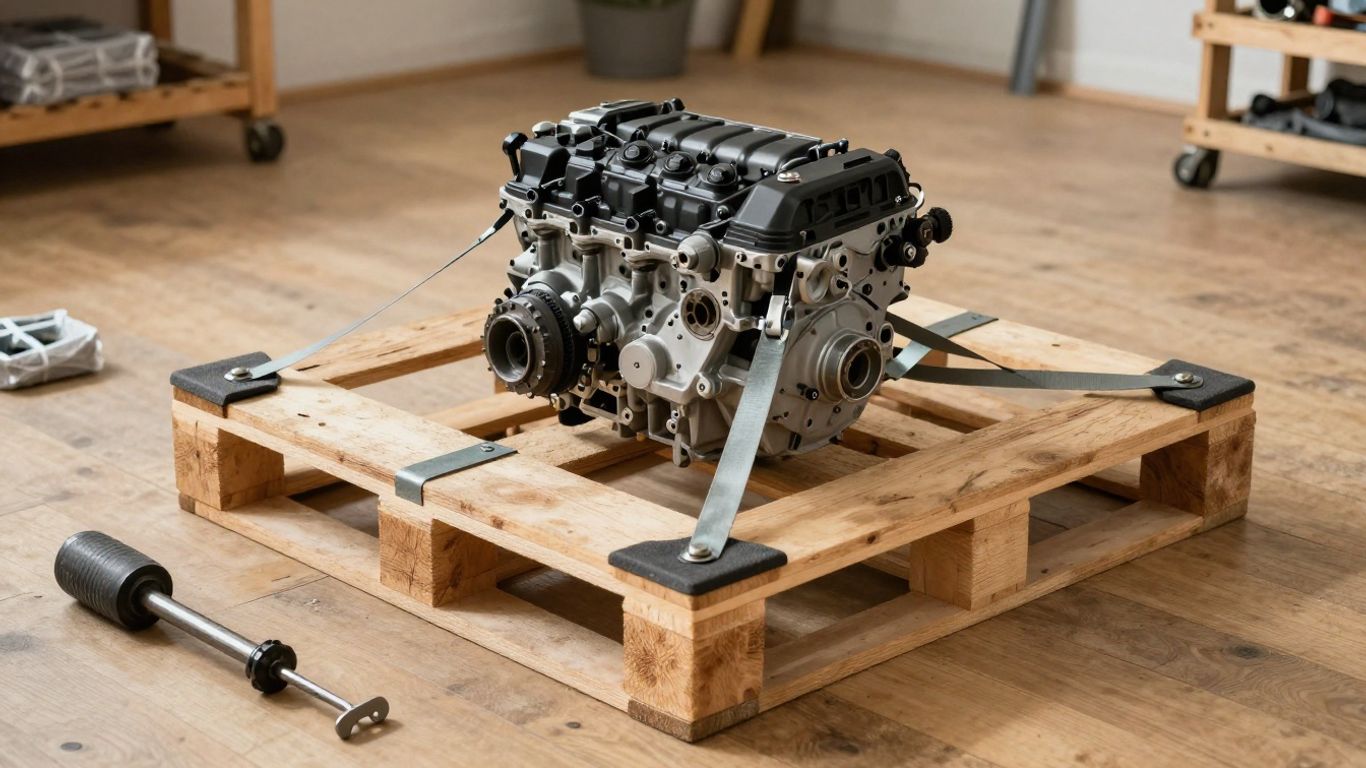
The safest packaging is not necessarily the most elaborate. It is the packaging that supports the load, shields vulnerable parts, contains residual fluids, and gives handlers a stable way to move the shipment.
Draining fluids and preventing leaks
Drain engine oil, coolant, fuel, and other service fluids before packing. Even a small amount of residual liquid can seep during transit, stain packaging, create a handling concern, or affect nearby freight. Allow time for the engine to drain fully, then fit suitable plugs or caps to open ports.
Wipe the exterior before wrapping it so that fresh leakage is easier to identify. Place absorbent material inside a sealed containment layer, but do not treat absorbent material as a substitute for draining and sealing. If any fluid remains for technical reasons, disclose it to the carrier before booking.
Protecting vulnerable engine components
Remove or firmly secure loose accessories, sensors, brackets, belts, hoses, and other parts that could break or become detached. Cover exposed openings and protect delicate connectors from impact, moisture, and abrasion. The crankshaft, sump, timing components, fuel equipment, and cooling connections may need particular attention depending on how the engine is configured.
Use rigid protection around projecting parts rather than relying on a thin plastic wrap. Padding should prevent contact with the crate or neighbouring freight while still allowing the load to be restrained. Take photographs after protection is fitted so the original condition is recorded.
Choosing crates, pallets, and secure packaging
A sound pallet is often suitable for a compact, stable engine, provided the load is centred and firmly bolted or strapped down. A crate gives more protection from side impacts and handling contact, but it must be strong enough for the total packed weight and must not obscure essential lifting points. Avoid placing the engine directly on loose timber or relying on stretch wrap to carry the load.
The packaging choice can be made more methodically by matching the risk to the shipment:
- Use a heavy-duty pallet when the engine has a stable base and can be mechanically secured.
- Use a crate when projecting components need protection from impact or contact.
- Add blocking to prevent rolling, sliding, or tipping during handling.
- Keep the centre of gravity as low and central as practical.
After packing, test for movement by applying careful hand pressure to the protected load. Any noticeable shift should be corrected before collection. The final package should remain stable if it is moved by forklift or pallet equipment.
Labelling the shipment correctly
Attach the delivery label to a visible, protected surface and place a duplicate inside the packaging where practical. Include the recipient’s name, business name if relevant, address, postcode, phone number, and consignment reference. Labels should remain readable after handling and should not be attached only to loose wrapping that can tear away.
Add handling information requested by the carrier, such as orientation or lifting-point guidance, but do not use labels as a substitute for physical restraint. The package still needs to be safe when the label is overlooked or damaged.
Choosing the right freight option
There is no single best method for every engine shipment. Standard road freight may be economical for a well-packed engine moving between accessible locations, while tailgate service or depot collection may solve a loading problem. Dedicated transport can suit time-sensitive or unusually valuable freight, though it usually costs more. Consider the engine, the route, the delivery site, and the consequences of delay together.
Road freight for standard deliveries
Road freight is the usual starting point for engines travelling between Australian cities and many regional centres. It works well when the engine is packed on a stable base, the pickup location can load it safely, and the recipient can receive a pallet or crate. Transit time depends on distance, route schedules, handling transfers, and local delivery conditions.
When requesting a quote, describe the shipment as accurately as possible. A vague description such as “car part” may not give the carrier enough information to price handling or allocate suitable equipment. A complete description helps reduce re-quoting and collection surprises.
Tailgate and depot-to-depot services
Tailgate delivery can help when the recipient does not have a forklift or loading dock. The vehicle’s tailgate can lower the pallet, but the site still needs a safe, level place where the freight can be received. Confirm whether the quoted service is tailgate delivery, kerbside delivery, or delivery to a carrier depot.
Depot-to-depot freight may be practical for remote destinations, restricted streets, workshops that can collect during business hours, or recipients who want more control over the final movement. Check depot opening hours, identification requirements, holding periods, and equipment available for collection before selecting this option.
Dedicated transport for urgent shipments
A dedicated vehicle may reduce handling transfers and provide a more direct schedule, which can be useful for a workshop waiting on a critical replacement. It is not automatically the fastest option in every case, because availability, route planning, and distance still matter. Ask for the actual collection window and delivery expectation rather than assuming priority means immediate arrival.
Dedicated transport can also make sense where an engine needs careful handling or where the pickup and delivery points are difficult for a general freight network. Compare the additional cost with the value of reduced handling and a more controlled movement.
Delivery options for remote and regional areas
Remote and regional deliveries need extra planning around road access, depot locations, service frequency, and unloading equipment. Some destinations may require a transfer to a local carrier or collection from a nearby freight terminal. The final distance can be short while the available service is still limited.
Provide clear directions, a local contact, and any site restrictions. If the property has a narrow driveway, soft ground, low branches, or no turning space, say so before booking. A depot option may be safer and less expensive than arranging an unsuitable vehicle for the final kilometre.
Estimating engine delivery costs
Engine freight pricing is shaped by more than kilometres. The carrier may consider actual weight, cubic volume, handling class, route, access, packaging, insurance, and whether the shipment needs special equipment. Quotes become more useful when those details are supplied together rather than added one at a time. Customers using the car parts network can often speed up the process by having the packed measurements ready when requesting delivery information.
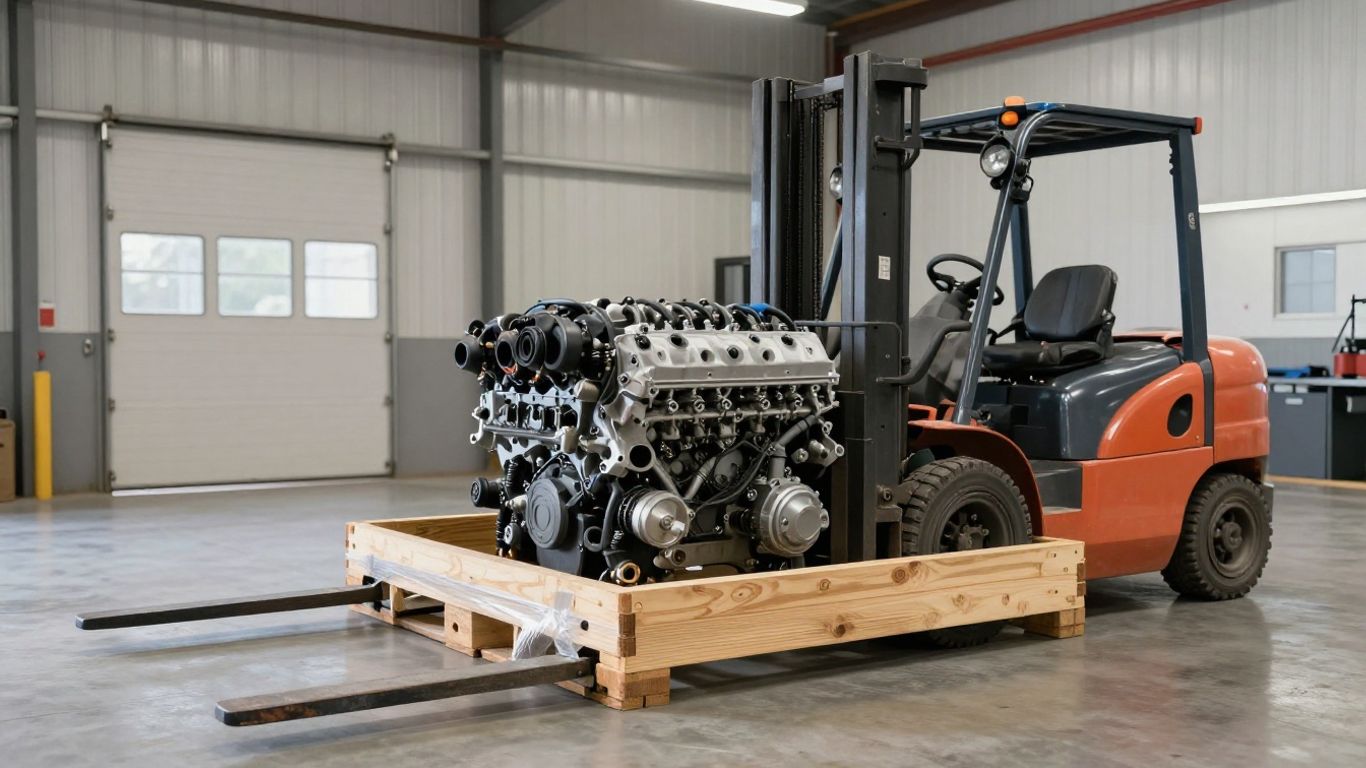
A low quote based on incomplete information may change later. An accurate quote may look higher at first but gives a clearer picture of the final cost.
How weight and dimensions affect pricing
Heavy freight is often priced by actual weight, cubic volume, or a combination of both. An engine that is compact but extremely heavy may need mechanical handling, while a lighter engine in a large crate can consume valuable floor space. Measure length, width, and height at the outside edges of the completed package.
Include the pallet or crate in the declared measurements. Also provide the total weight of the packed shipment, not an estimate copied from an engine specification sheet. If the weight is uncertain, arrange a proper measurement before booking or tell the provider that the figure is provisional.
The impact of pickup and delivery locations
A metropolitan business address with a loading dock is generally simpler to service than a residential property with restricted access. Regional and remote destinations can involve additional line-haul distance, transfer points, depot collection, or special delivery arrangements. Pickup conditions matter just as much as the destination.
The postcode, property type, operating hours, and available equipment should all be included in the quote request. If a carrier arrives and discovers that the site cannot safely load or unload the engine, a rebooking or waiting charge may follow.
Insurance, handling, and accessorial charges
Ask whether transit cover is included, optional, or excluded, and check the value limit and claim conditions. Separate charges may apply for tailgate use, residential delivery, limited access, storage, re-delivery, dangerous or leaking goods, and manual handling. These fees are not necessarily unreasonable; they reflect work outside a standard freight movement.
A useful quote should make the service assumptions visible. Compare like with like by checking whether the price includes collection, delivery, tracking, insurance, and the handling equipment needed at both ends.
| Cost factor | Why it can change the quote | Detail to provide |
|---|---|---|
| Packed weight | Determines handling requirements and freight class | Total weight including pallet or crate |
| Packed dimensions | Affects space used in the vehicle | Length, width, and height |
| Route and postcode | Influences distance and service availability | Exact pickup and delivery postcodes |
| Site access | May require tailgate, depot, or special equipment | Dock, forklift, driveway, and hours |
| Protection and cover | Adds packaging, handling, or insurance costs | Crate type, declared value, and exclusions |
Reading the quote line by line helps reveal which price is genuinely lower. It also gives you a list of questions to resolve before the engine is collected.
Ways to reduce shipping costs
The most practical savings usually come from reducing uncertainty and avoiding unnecessary handling. Pack the engine securely before collection, provide accurate measurements, and use a commercial address when that is genuinely convenient and suitable. A depot collection can also reduce final-mile complexity, but only if the recipient can safely move the engine from the depot.
Avoid cutting protection to save a small amount. Damaged components, failed collection attempts, storage, and re-delivery can cost far more than sound packaging. Ask whether flexible pickup dates or consolidated road freight are available, then compare the saving with the extra waiting time.
Booking engine delivery anywhere in Australia
A good booking begins with a complete freight brief. The carrier needs to understand what is moving, how it is packed, where it is going, and what both locations can handle. Giving those details at the start makes the comparison fairer and reduces last-minute changes. The car parts network can be useful when customers are coordinating part sourcing with delivery, but the shipment still needs its own accurate freight information.
Preparing accurate shipment details
Write down the engine type, packed weight, packed dimensions, packaging method, declared value, and whether any components remain attached. Add the pickup and delivery addresses, postcodes, contact names, phone numbers, opening hours, and access information. Mention whether the locations are residential, commercial, workshop, farm, or depot sites.
Photographs can clarify the package and the available loading area. They are especially helpful when the engine is large, unusually shaped, or being collected from a site without a dock. Keep a copy of everything submitted with the booking confirmation.
Comparing freight providers and quotes
Compare providers on the actual service, not just the base price. Check collection timing, estimated transit, tracking, handling equipment, insurance terms, exclusions, delivery method, and what happens if nobody is available. A quote that omits a necessary service may not be the cheaper option after adjustments.
Read the conditions before accepting. If the provider needs a final weight, photographs, or confirmation of access, supply it in writing and ask for the revised quote. This creates a clearer record of what the carrier agreed to move.
Confirming pickup and delivery requirements
Before collection, confirm that the engine is drained, secured, labelled, and ready at the stated time. Make sure someone at the pickup site understands how the carrier will load it and that the receiving site has the required equipment or has arranged depot collection. Keep walkways and loading areas clear.
At delivery, the recipient should know whether the carrier will bring the engine to the property, lower it at the kerb, or hold it at a depot. Clarifying this beforehand prevents a heavy crate from being left in an unsafe or inaccessible position.
Tracking the engine during transit
Use the consignment reference supplied by the carrier and monitor status changes without assuming every scan means the engine has physically moved. Freight may be waiting for a transfer, an available vehicle, or a delivery appointment. If an update appears stalled beyond the quoted window, contact the carrier with the reference and the original booking details.
Keep the recipient available around the expected delivery period. A missed call or unavailable site can create a re-delivery delay, particularly in regional areas where services run less frequently.
Managing delivery risks and compliance
Heavy freight carries practical risks that are easier to manage when they are discussed before dispatch. The main concerns are leakage, unstable packaging, incorrect declarations, access problems, damage, and uncertainty about cover. A written record of the engine’s condition and the agreed service gives both sender and recipient a stronger basis for resolving issues.
Understanding freight insurance coverage
Insurance terms vary, so check what is covered, the maximum claim value, exclusions, excess, evidence requirements, and the time limit for notification. Some policies may require proper packaging, declared value, photographs, or inspection by the carrier. Transit cover does not necessarily protect against poor packing, pre-existing damage, corrosion, or excluded fluids.
Do not assume that a carrier’s liability equals the engine’s replacement value. If the engine is valuable or difficult to replace, ask specifically about available cover and retain purchase documents, photographs, and identifying numbers.
Handling damaged or delayed shipments
If the packaging arrives damaged, photograph it before opening where practical. Note visible damage on the delivery record and contact the carrier promptly. If the engine itself is affected, keep the packaging and do not discard broken restraints or protective material until the claim process is complete.
A delay should be reported with the consignment number, pickup date, expected delivery window, and current destination information. Calm, specific communication usually makes it easier for the carrier to locate the freight and explain the next step.
Checking carrier terms and exclusions
Read the conditions for prohibited goods, leaking freight, fragile components, collection failure, storage, re-delivery, remote areas, and limited-access addresses. Some services may not accept an engine unless it is drained, palletised, or suitable for forklift handling. The terms may also set a time limit for reporting damage.
Ask questions about any clause that does not match the shipment. A short written clarification is preferable to relying on a verbal assumption made during a quick booking call.
Meeting Australian transport requirements
The engine must be packed and declared in a way that allows the carrier to handle it safely under applicable transport and workplace requirements. Do not send fuel, oil, coolant, batteries, or other regulated materials without checking the carrier’s rules. Requirements can differ according to the material, quantity, packaging, and transport service.
The sender remains responsible for describing the shipment honestly and preparing it safely. When uncertain, ask the carrier what documentation or packaging standard applies before the engine is collected.
Receiving and inspecting the engine
Receiving the engine is the final part of the freight process, not an afterthought. Have a clear space ready, make sure the recipient knows the expected delivery method, and keep the booking information nearby. A few minutes of careful inspection can protect the recipient’s position if something has gone wrong in transit.
Preparing the delivery location
Clear a firm, level area large enough for the pallet or crate and the unloading equipment. Remove obstacles, protect floors where needed, and ensure the access route is suitable for the delivery vehicle. If the engine is being delivered to a residence or workshop, confirm who will receive it and how it will be moved after unloading.
Do not improvise with unsafe lifting equipment. If the engine cannot be moved safely at the destination, arrange suitable help before delivery rather than asking the driver to perform work outside the booked service.
Inspecting packaging before signing
Look for crushed boards, broken straps, punctures, shifted blocks, fluid staining, torn wrapping, and impact marks. Compare the package with the photographs taken before dispatch. If the delivery record allows comments, describe visible damage before signing and ask the driver about the correct reporting process.
A clean exterior does not prove that the engine is undamaged, but obvious packaging damage should not be ignored. Take clear photographs from several angles while the freight is still in its delivered condition.
Documenting damage or missing parts
Open the package carefully and compare the engine with the original description, photographs, and packing list. Check accessories, brackets, sensors, covers, and loose components, not just the main block. Record missing or damaged items with close-up photographs and a short factual description.
Notify the sender and carrier promptly, following the claim timeframe in the freight terms. Keep the crate, pallet, wrapping, restraints, and other packaging until the matter is resolved. Avoid repairs or disposal before the carrier confirms what evidence is required.
Storing the engine after delivery
Store the engine on a stable, supported surface away from standing water, dust, accidental impact, and extreme exposure. Keep openings protected and maintain any covers fitted for transport. If the engine will not be installed soon, follow appropriate preservation advice for the specific assembly.
Record the delivery date, condition, identifying numbers, and storage location. Good records connect the delivered engine to the freight booking and make later inspection, installation, or warranty discussions easier.
Conclusion
Engine delivery anywhere in Australia becomes far more manageable when the shipment is measured accurately, drained and secured properly, matched with the right freight service, and inspected carefully on arrival. Clear communication about access, insurance, timing, and packaging helps avoid surprises, while a few extra minutes of preparation can protect both the engine and the delivery budget.